If you have ash trees on your property in Hartford County, there’s a good chance they’re under attack. The emerald ash borer, a small, metallic-green beetle from Asia, has been killing ash trees across Connecticut for more than a decade. Untreated ash trees rarely survive it, and once they die they can become dangerous quickly.
Here’s how to tell whether you have an ash tree, what emerald ash borer damage looks like, and how to decide between treatment and removal.
Emerald ash borer in Hartford County
Emerald ash borer was first confirmed in Connecticut in 2012, in the town of Prospect. A year later it turned up in Hartford County, with a detection in Southington, and it has since been found across the state, including in Hartford’s Keney Park. The beetle’s larvae tunnel under the bark and cut off the flow of water and nutrients, so an infested tree slowly starves from the inside.
For the latest state guidance, see the Connecticut DEEP emerald ash borer page.
Is it an ash tree?
Before you worry about the beetle, confirm the species. Ash trees have a few features that make them fairly easy to spot:
- Branches and buds grow in opposite pairs, directly across from each other.
- Leaves are compound, with 5 to 9 leaflets on each leaf stem.
- Mature trees have bark with a tight, diamond-shaped pattern of ridges.
- In fall, white ash leaves often turn yellow to deep purple.
If you’re not sure, a tree professional can identify it during an on-site visit.
Signs of emerald ash borer damage
- Thinning from the top. The upper canopy loses leaves first, and dead branches appear near the top of the tree.
- D-shaped exit holes. Adult beetles leave small, D-shaped holes about 1/8 inch wide in the bark.
- Woodpecker damage. Woodpeckers strip bark to get at the larvae, leaving pale patches on the trunk, often called “blonding.”
- Bark splits. Vertical cracks in the bark can reveal S-shaped tunnels underneath.
- Sprouts on the trunk. A stressed ash often pushes out clusters of new shoots low on the trunk or at the base.
One sign on its own doesn’t always mean emerald ash borer, but several together on an ash tree are a strong warning.
Why a dead ash tree can’t wait
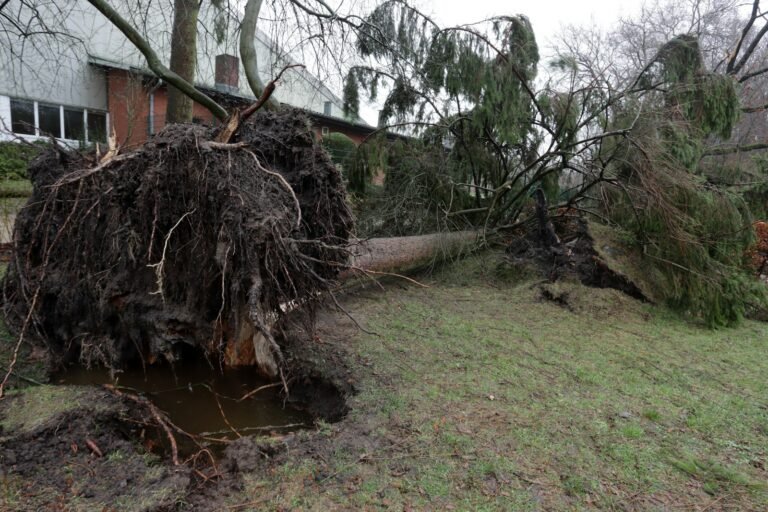
Many trees stand for years after they die. Ash usually doesn’t. Once an ash dies, its wood dries out and turns brittle, and large limbs, or the whole top of the tree, can break without warning, even on a calm day.
That creates two problems for homeowners:
- Safety. A brittle ash near a house, driveway, street or power line is a real hazard to people and property.
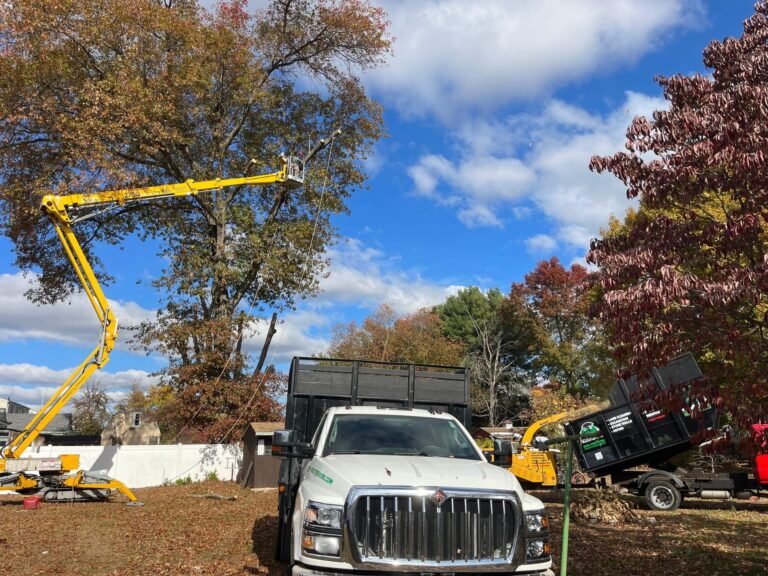
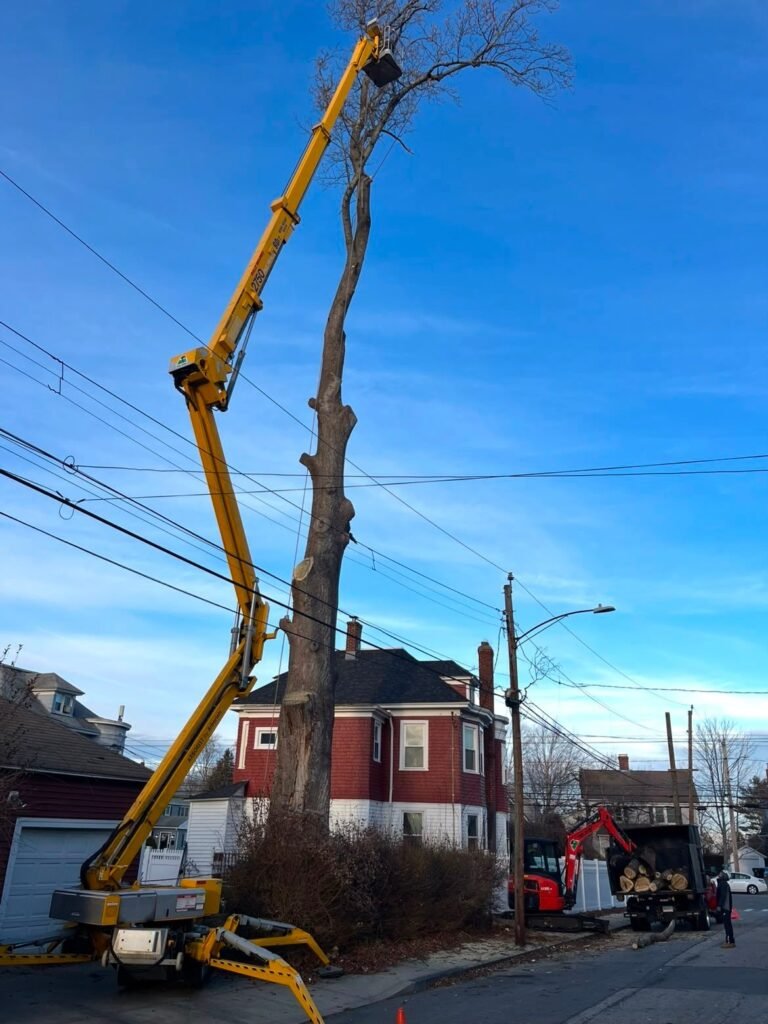
- A harder removal. Dead ash is often too brittle to climb safely, so crews rely on aerial lifts and careful rigging. The longer a dead ash stands, the more complicated, and often the more costly, the job becomes.
If a dead or dying ash is near power lines, the utility may need to be involved before the tree can come down. Ash trees along Hartford city streets should be reported through Hartford 311. If a tree has already come down, see our guide to emergency tree removal in Hartford.
Worried about an ash tree in your yard?
We’ll assess the tree, explain your options and give you a free estimate if it needs to come down.
Request an ash tree assessment
Treat it or remove it?
Not every ash has to be cut down. The right choice depends on the tree’s condition, how much it matters to you and where it stands.
When treatment may make sense
A healthy, valuable ash with most of its canopy intact can often be protected with insecticide treatments applied by a licensed pesticide applicator. Treatment has to be repeated on a schedule to keep working, so it’s a long-term commitment, best saved for the trees that matter most, such as a large shade tree next to the house.
When removal is the safer choice
Trees that have already lost a large share of their canopy, show heavy woodpecker damage or are shedding bark are usually past saving. Removing them before they turn brittle is safer and usually simpler.
Replant with something different
If you remove an ash, consider replacing it with a different species, so your yard has a mix of trees that won’t all fall to a single pest.
Don’t move ash firewood
Moving firewood is one of the main ways tree pests spread. Connecticut still regulates moving firewood into and within the state, so keep ash wood local and buy firewood where you plan to burn it.
Ash tree removal across Hartford County
CT Tree Work LLC removes dead and dying ash trees in Hartford, West Hartford, East Hartford, Wethersfield, Newington, Glastonbury, Farmington, Bristol, Southington and nearby towns. Learn more about our tree removal services, or read our guide to tree removal in Hartford.
Request a free estimate or call (860) 795-6196 before that ash tree becomes an emergency.